
In This Article – The Basic Idea – Why Every Type Has a Fear and a Desire – The 9 Types, in One Line Each – The 3 Centers: Gut, Heart, and Head – What Makes the Enneagram Different From Other Tests – How People Actually Use It
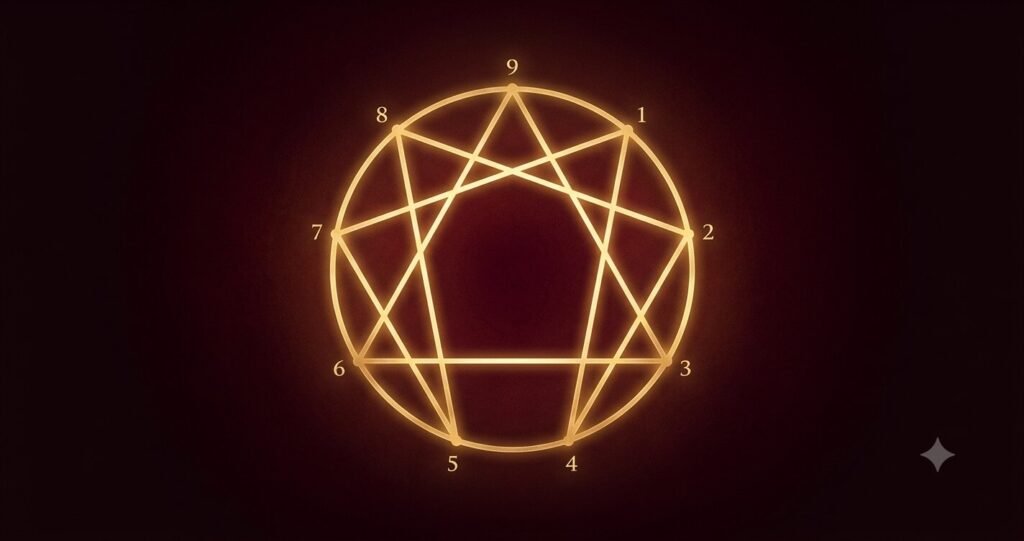
The Enneagram is a map of nine personality types. Each type is built around one core fear and one core desire. Once you know your fear and your desire, a lot of your own patterns start to make sense.
That’s really the whole idea. Everything else — the numbers, the arrows, the wings — builds on top of that simple base.
The Basic Idea
Picture nine different people in the same hard situation. A missed deadline. A fight with a friend. A last-minute change of plans. Each person will react in their own way. But look closely, and you’ll see the reaction isn’t random.
A Type 1 will feel like something was done wrong, and want to fix it. A Type 6 will feel unsafe, and look for reassurance. A Type 9 will feel the tension, and want it to just go away. Nine different people, nine different core patterns, all showing up in the same moment.
The Enneagram gives a name to each of these patterns. Not to box people in, but to help them see what’s actually driving their own behavior.
Why Every Type Has a Fear and a Desire
Here’s the part that makes the Enneagram different from a lot of quizzes. It’s not just “are you more outgoing or more quiet.” Every single type is built around two things:
- A core fear — the thing that type is quietly trying to avoid
- A core desire — the thing that type is quietly trying to get
Most of what a person does, especially under stress, traces back to one of these two things. Someone who checks their phone forty times a day might be a Type 6, quietly trying to feel safe. Someone who can’t stop working might be a Type 3, quietly trying to feel valuable. The behavior on the surface looks different for every type. The engine underneath is always fear and desire.
See also: Enneagram Type 6 and Enneagram Type 3 — two good examples of how fear and desire drive very different behavior.

The 9 Types, in One Line Each
| Type | Name | Wants | Fears |
| 1 | The Reformer | To be good and do things right | Being wrong or flawed |
| 2 | The Helper | To feel loved and needed | Being unwanted |
| 3 | The Achiever | To feel valuable and admired | Being worthless |
| 4 | The Individualist | To find real meaning and identity | Having no identity at all |
| 5 | The Investigator | To feel capable on their own | Being useless or overwhelmed |
| 6 | The Loyalist | To feel safe and supported | Being without support |
| 7 | The Enthusiast | To stay happy and free | Being trapped in pain |
| 8 | The Challenger | To stay in control | Being controlled by others |
| 9 | The Peacemaker | To keep the peace | Conflict and separation |
See also: The Reformer, The Helper, and the other seven type guides — for a full breakdown of each one.
The 3 Centers: Gut, Heart, and Head
The 9 types also sort into three smaller groups, called centers. This part trips a lot of people up at first, but it’s actually simple once you see it.
Gut types (8, 9, 1) run mostly on instinct and control. They react fast, often before they’ve thought it through. Their main emotion, underneath everything, is anger — though it shows up in very different ways for each of the three.
Heart types (2, 3, 4) run mostly on feelings and image. They care a lot about how they’re seen, and how they connect with others. Their main emotion is shame — a quiet sense of not being enough as they are.
Head types (5, 6, 7) run mostly on thinking. They plan, analyze, and try to feel prepared. Their main emotion is fear — worry about what might go wrong.
See also: Enneagram Centers: Gut, Heart, and Head — for a much deeper look at this part.

What Makes the Enneagram Different From Other Tests
A lot of personality tests ask what you like. The Enneagram asks what you’re afraid of. That’s a much harder question, and it usually gets a much more honest answer.
It also doesn’t stop at “here’s your type.” It also has wings (the types next to yours that shade your personality), and arrows (patterns that show up when you’re stressed or growing). This makes it feel less like a label and more like a real map you can keep learning from.
See also: Enneagram Wings Explained — for how a nearby type can shape your whole personality.
How People Actually Use It
Most people don’t just read their type once and forget it. They come back to it. When they’re stuck in the same fight with a partner again. When they can’t figure out why a certain kind of feedback stings so much. When they want to grow, but don’t know where to start.
Knowing your type doesn’t fix anything by itself. But it does something useful: it gives you a name for the pattern. And once something has a name, it’s a lot easier to catch it happening — and choose something different.
A Quick Example of How This Plays Out in Real Life
Say two coworkers both get the same piece of harsh feedback from a boss. One of them, a Type 3, feels a jolt of real fear — not fear of the boss exactly, but fear that they’re now seen as less capable. They might work late that night, trying to prove the feedback wrong. The other coworker, a Type 9, feels something different: a kind of internal shutdown. They might go quiet, agree with everything the boss said, and avoid the topic for days.
Same feedback. Same room. Two totally different inner experiences. Neither reaction is wrong. But if you don’t know your own pattern, both of these coworkers might spend years confused about why this keeps happening to them, without ever connecting it to something deeper and more consistent about how they’re built.
Why People Get Their Type Wrong So Often
Here’s something worth knowing before you take any test: a lot of people guess their type based on behavior alone, and get it wrong. Two very different types can look almost the same from the outside.
A Type 3 who’s driven to achieve and a Type 1 who’s driven to do things right can both look like “hard workers” to everyone around them. But the reason underneath is completely different — one is chasing admiration, the other is chasing correctness. This is exactly why a real test, built around the actual fear and desire behind the behavior, works so much better than trying to guess from a short description alone.
Frequently Asked Questions
Is the Enneagram the same as Myers-Briggs? No. Myers-Briggs looks at how you think and make decisions. The Enneagram looks at what you fear and what you want deep down. They’re different tools that answer different questions.
Can I be more than one type? Your main type stays fairly steady, but everyone has a wing (a nearby type that adds flavor) and stress/growth patterns that pull toward two other types. So yes, in a way — your main type is never the whole story.
Is the Enneagram scientifically proven? It’s a self-reflection tool, not a lab-tested science. It’s based on real patterns people have noticed for a long time, but it hasn’t been studied the same way psychologists study things like personality traits in formal research. It’s still genuinely useful — just don’t treat it as hard fact.
How do I find out my type? The most reliable way is a real test, made up of specific questions about your fears, wants, and habits — not just a quick guess based on a short description.
Where to Start
The Enneagram Test is a free assessment built around all 9 types, their fears, and their desires. Take the free assessment to find your type.
Pingback: Best Careers by Enneagram Type: The Essential Guide to Avoid Mistakes
Pingback: Enneagram Compatibility: The Honest Truth About Which Pairs Struggle
Pingback: Enneagram Growth: The Real Struggle After Knowing Your Type
Pingback: Find Your Enneagram Type: A Proven Way to Avoid This Mistake