
In This Article – Where the 12 Archetypes Actually Come From – The 12 Archetypes, Grouped by What They Want – The 12 Archetypes at a Glance – Why This Isn’t the Same as Myers-Briggs or the Enneagram – How the Test Actually Works
The 12 Jungian archetypes describe recurring personality patterns — the Hero, the Sage, the Lover, the Outlaw, and nine others — that show up across cultures, mythology, literature, and everyday behavior. The model is widely used today for both personal self-discovery and brand strategy, and understanding where it actually comes from makes it far more useful than treating it as a simple label.
Where the 12 Archetypes Actually Come From
The concept of archetypes originates with Carl Jung, the Swiss psychiatrist who proposed that certain universal patterns — the Hero, the Shadow, the Wise Old Man, and others — live in what he called the collective unconscious, a shared layer of the psyche inherited across humanity rather than learned individually. Jung himself never organized these patterns into a fixed list of exactly 12.
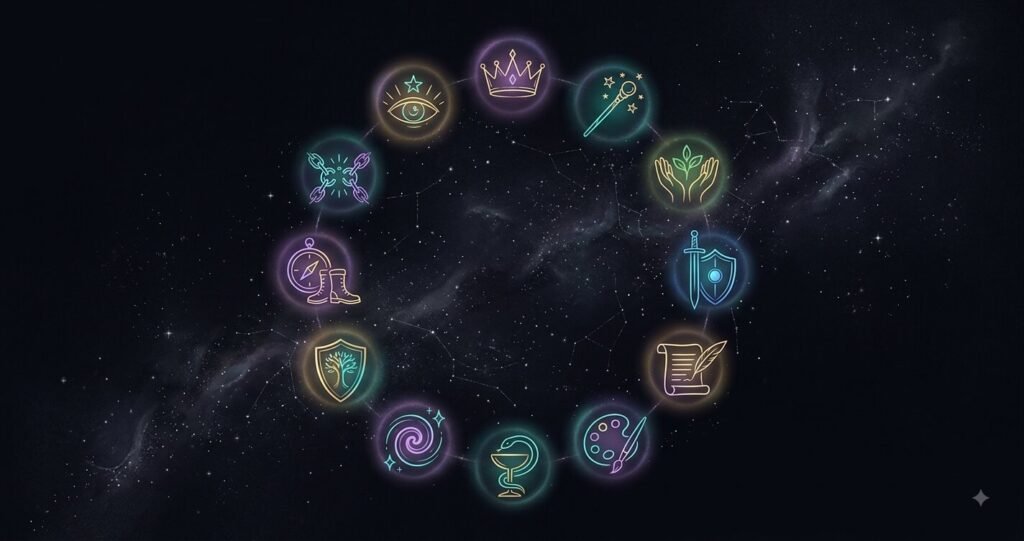
The specific 12-archetype framework most people encounter today — Innocent, Sage, Explorer, Outlaw, Magician, Hero, Lover, Jester, Everyman, Caregiver, Ruler, and Creator — was developed later by Carol S. Pearson and Margaret Mark, first published in their 2001 book The Hero and the Outlaw: Building Extraordinary Brands Through the Power of Archetypes. Their model adapted Jung’s broader ideas into a practical 12-type system, originally intended for brand strategy but quickly adopted for personal self-reflection as well. This is why the same 12 archetypes are sometimes called “brand archetypes” in marketing contexts and “Jungian archetypes” in personality contexts — both terms refer to the same underlying 12-type model.
See also: “Brand Archetypes Explained: Where the 12-Type Model Actually Comes From” — for a deeper look at this history.
The 12 Archetypes, Grouped by What They Want
Each of the 12 archetypes is organized around a core desire and a core fear. Grouping them by what drives them makes the full set easier to hold in mind than memorizing 12 unconnected labels — and it’s the same five-category grouping used to score results on the Personality Archetype Test itself.
Motivation-Centered Archetypes
The Innocent wants paradise and simplicity; the Sage wants truth and understanding; the Explorer wants freedom and authentic self-discovery. All three are driven primarily by what they want to experience or discover.
Behavior-Centered Archetypes
The Outlaw wants to destroy what doesn’t work; the Hero wants to prove worth through courageous action; the Caregiver wants to protect others through service. All three are driven by what they want to do or accomplish through direct action.
Cognition-Centered Archetypes
The Magician wants to transform reality itself; the Ruler wants to create order and control outcomes; the Creator wants to bring something new and lasting into existence. All three are driven by understanding, transformation, or control through insight and strategic thinking.
Emotion-Centered Archetypes
The Lover wants intimacy and sensual connection; the Jester wants joy in the present moment. Both are driven primarily by feeling — passion, presence, and emotional experience.
Connection-Centered Archetypes
The Everyman wants to belong above all else, prioritizing relationship and shared experience over individual achievement or standing out.
The 12 Archetypes at a Glance
| Archetype | Core Desire | Core Fear |
| Innocent | Paradise and purity | Being punished for wrongdoing |
| Sage | Truth and understanding | Being misled or ignorant |
| Explorer | Freedom and self-discovery | Being trapped or confined |
| Outlaw | Destroying what doesn’t work | Being powerless |
| Magician | Transforming reality | Unintended negative consequences |
| Hero | Proving worth through courage | Being weak or vulnerable |
| Lover | Intimacy and connection | Being alone or unloved |
| Jester | Living fully in the moment | Being bored or boring others |
| Everyman | Belonging and connection | Standing out or being left out |
| Caregiver | Protecting others | Being selfish or unhelpful |
| Ruler | Order and control | Chaos or losing control |
| Creator | Making something enduring | Creating something mediocre |
See also: “The Hero”, “The Sage”, and the other ten individual archetype guides — for a full breakdown of each type’s strengths, challenges, careers, and relationship patterns.
Why This Isn’t the Same as Myers-Briggs or the Enneagram
The 12 Jungian archetypes are frequently confused with other personality systems, but they measure something genuinely different. Myers-Briggs categorizes cognitive preferences — how a person processes information and makes decisions. The Enneagram maps core motivations and stress patterns tied to childhood coping strategies. The 12-archetype model instead maps narrative role: which universal character a person’s personality most resembles, drawing on shared story patterns found in mythology and culture rather than cognitive function or developmental psychology. None of these systems is more “correct” than the others — they’re different lenses on personality, and many people find value in comparing results across more than one.

How the Test Actually Works
A structured assessment built around this model typically presents a series of situational and preference-based questions, then scores responses against each of the 12 archetype profiles to identify a dominant type, along with secondary archetypes that also show up strongly. Most people don’t express a single archetype in pure form — a dominant pattern usually shows up alongside two or three supporting ones that surface in specific contexts, such as work, relationships, or periods of stress. This is also where the concept of a shadow archetype becomes relevant: the pattern that tends to emerge specifically under pressure, often quite different from a person’s dominant everyday archetype.
See also: “What Is a Shadow Archetype (and Why Yours Matters More Than Your Main One)” — for more on this specific concept.
Why Jung Developed the Concept of Archetypes in the First Place
Jung arrived at the idea of archetypes through his clinical work, noticing that patients across radically different backgrounds and cultures reported strikingly similar symbolic imagery in dreams and fantasies — recurring figures like a wise old guide, a devouring monster, or a nurturing mother, regardless of whether the patient had any exposure to the mythologies where those same figures appear.
Jung concluded these patterns couldn’t be explained by personal experience alone, and proposed instead that they were inherited structures of the psyche, shared across humanity the way physical traits are inherited biologically. This is a genuinely bold claim, and it remains debated in contemporary psychology — but the practical observation behind it holds up well regardless of the underlying explanation: certain character patterns really do repeat with striking consistency across unrelated cultures, eras, and individual lives.
How the 12-Type Model Differs From Jung’s Original Ideas
It’s worth being precise about this distinction, since it’s often blurred. Jung’s own writing identified several archetypal figures — the Shadow, the Anima and Animus, the Wise Old Man, the Great Mother, the Self — but he described these as a flexible, evolving set of patterns rather than a fixed taxonomy of exactly 12 personality types.
The specific, tidy 12-archetype model most quizzes and articles reference today is a later adaptation, built by Pearson and Mark specifically to be practical and applicable — easy to test for, easy to apply to branding or self-reflection, and easy to explain in a single sitting. This doesn’t make the 12-type model illegitimate; it simply means it’s one useful simplification of Jung’s broader, messier original theory, not a direct transcription of it. Understanding this distinction helps set realistic expectations: the 12-archetype model is a practical tool built on genuine psychological insight, not a word-for-word representation of decades of Jungian clinical theory.
Why the Number 12 Specifically
A reasonable question is why Pearson and Mark settled on exactly 12 archetypes rather than a different number entirely. Their reasoning drew on the observation that human motivation tends to cluster around a manageable set of recurring goals — safety, freedom, mastery, connection, order, transformation, and so on — and that 12 was roughly the number needed to cover this territory without either oversimplifying into a handful of vague categories or fragmenting into dozens of overlapping micro-types.
This mirrors a pattern seen across other typology systems: the Enneagram settled on nine, the Chinese zodiac on twelve, and Myers-Briggs on sixteen — different numbers, but all reflecting a similar tradeoff between comprehensiveness and usability. Twelve happens to divide cleanly into smaller conceptual groups too, which is part of why category-based groupings work so well as an organizing layer on top of the individual types.
See also: “Motivation, Behavior, Cognition, Emotion, and Connection: How the 12 Archetypes Are Actually Grouped” — for a full breakdown of this category structure.
Why This Model Endures Despite Its Age
More than two decades after its original publication, the 12-archetype framework has shown notable staying power in an industry — both marketing and self-help — known for rapid turnover of trendy new systems. Part of the explanation is practical: the framework is genuinely easy to teach and apply, requiring no specialized training to grasp the basics, unlike more clinically complex instruments.
But part of the explanation is also structural: by grounding itself in mythology and story rather than purely modern psychological categories, the 12-archetype model taps into patterns people already recognize intuitively from a lifetime of exposure to narrative — fairy tales, films, novels, religious texts — rather than asking them to learn an entirely unfamiliar vocabulary from scratch. This built-in familiarity is likely a significant part of why the framework continues to resonate across both commercial and personal contexts, even as more clinically rigorous personality models have gained ground in academic psychology over the same period.
How Archetypes Show Up Across Mythology and Story
One of Jung’s central observations was that these patterns repeat across cultures with no direct contact with one another — a detail worth sitting with, since it’s part of what makes archetypal patterns feel so recognizable regardless of background. The wandering hero who leaves home to face a trial appears in Greek epic, West African oral tradition, and Norse saga alike. The wise elder who guides a younger protagonist through knowledge rather than force shows up just as consistently across unrelated storytelling traditions.
The trickster who upends order through wit rather than strength appears from Native American coyote tales to West African Anansi stories to Norse Loki myths. This cross-cultural consistency is precisely the evidence Jung pointed to when arguing that these patterns reflect something inherited rather than culturally transmitted — a claim that remains genuinely debated among scholars, but one that at minimum helps explain why the 12-archetype framework tends to feel intuitively recognizable even to people encountering it for the very first time.
Wikipedia’s entry on Jungian archetypes covers how this framework connects to Jung’s wider theory of the collective unconscious.
Frequently Asked Questions
Who created the 12 Jungian archetypes? Carl Jung’s broader theory of archetypes and the collective unconscious laid the psychological foundation, but the specific 12-type model was developed later by Carol S. Pearson and Margaret Mark, first published in 2001.
Are the 12 archetypes scientifically validated? The 12-archetype model is best understood as a psychoeducational self-reflection tool rather than a clinically validated diagnostic instrument. It draws on real psychological theory but functions similarly to other popular typology systems — useful for insight, not for clinical diagnosis.
Can someone have more than one archetype? Yes. Most people have one dominant archetype along with two or three secondary archetypes that show up in different contexts, plus a distinct shadow archetype that tends to emerge under stress.
What’s the difference between a Jungian archetype and a brand archetype? They refer to the same 12-type model — “brand archetype” is the term used in marketing contexts (since Pearson and Mark’s original framework was designed for brand strategy), while “Jungian archetype” or “personality archetype” is the term used in personal self-discovery contexts.
Where to Start
The Personality Archetype Test is a free 60-question assessment based on this exact 12-archetype model, identifying a dominant archetype, supporting archetypes, and a shadow archetype pattern. Take the free assessment to find out which one fits.