
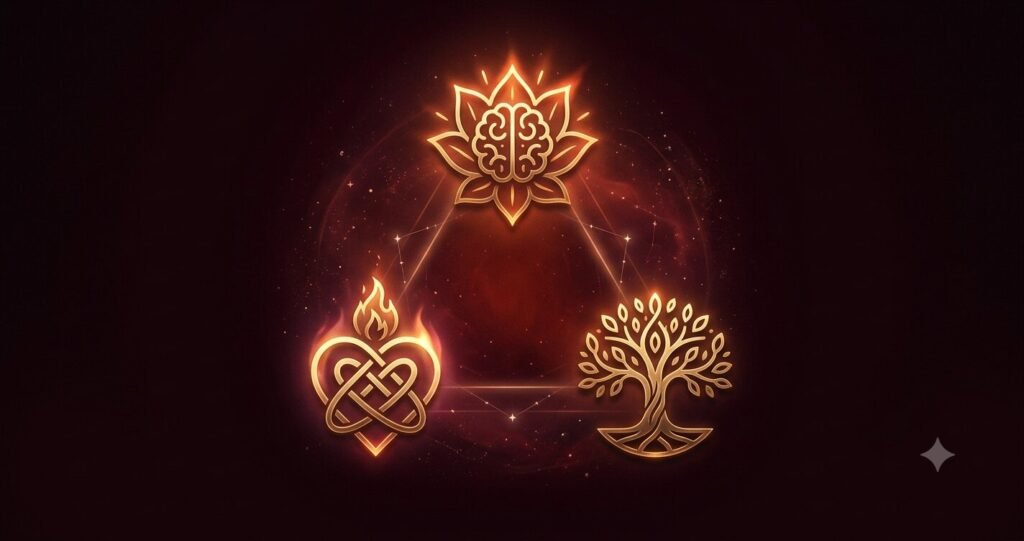
In This Article – Why the 9 Types Come in 3 Groups – The Gut Center: Types 8, 9, and 1 – The Heart Center: Types 2, 3, and 4 – The Head Center: Types 5, 6, and 7 – Why Your Center Matters as Much as Your Type
Before there were 9 Enneagram types, there were 3 centers. Every type belongs to one of them: gut, heart, or head. Knowing your center is like knowing your team before you know your exact position on it. Lets discuss enneagram centers in detail
Why the 9 Types Come in 3 Groups
Each center runs on one main emotion. Not a mood that comes and goes — a deep, quiet feeling that sits underneath everything that center does.
Gut types run on anger. Heart types run on shame. Head types run on fear. Every type in a center shares that same underlying feeling. What changes from type to type is what they do with it. Neuroscience’s triune brain model draws a loosely similar line between instinct, emotion, and reasoning, though it maps to brain structures rather than personality types.
Think of it like three people who all feel the exact same emotion, but each one deals with it in their own way. That’s basically what a center is.
The Gut Center: Types 8, 9, and 1
Gut types (8, 9, and 1) trust their body more than their thoughts. They react fast. They know what they feel before they can explain why.
The shared feeling here is anger. But look how different it looks on each type:
- Type 8 (the Challenger) lets the anger out. Loud, direct, hard to miss.
- Type 9 (the Peacemaker) pushes the anger down so far, they often don’t notice it’s there at all.
- Type 1 (the Reformer) turns the anger into self-control. It comes out as strict standards, not outbursts.
Same feeling. Three totally different faces.
See also: The Challenger (Type 8), The Peacemaker (Type 9), and The Reformer (Type 1) — for the full story on each gut type.

The Heart Center: Types 2, 3, and 4
Heart types (2, 3, and 4) care deeply about connection and image — how they’re seen, and how they matter to other people. The shared feeling here is shame, a quiet sense that who they really are might not be enough.
- Type 2 (the Helper) copes by becoming needed. If people rely on them, the shame gets quieter.
- Type 3 (the Achiever) copes by becoming impressive. If people admire them, the shame gets quieter.
- Type 4 (the Individualist) copes by leaning into being different. If their pain and identity feel special, the shame turns into meaning instead.
The 3 Centers at a Glance
| Center | Types | Main Feeling | How It Shows Up |
| Gut | 8, 9, 1 | Anger | Instinct, control, action |
| Heart | 2, 3, 4 | Shame | Image, connection, feelings |
| Head | 5, 6, 7 | Fear | Thinking, planning, safety |
See also: The Helper (Type 2), The Achiever (Type 3), and The Individualist (Type 4) — for the full story on each heart type.

The Head Center: Types 5, 6, and 7
Head types (5, 6, and 7) live mostly in their thoughts. They plan. They prepare. They try to feel ready for whatever’s coming. The shared feeling here is fear — not always obvious fear, but a steady hum of “what if something goes wrong.”
- Type 5 (the Investigator) copes by learning everything they can. Knowledge feels like safety.
- Type 6 (the Loyalist) copes by staying alert and asking “what if.” Preparing for danger feels like safety.
- Type 7 (the Enthusiast) copes by staying busy and upbeat. Options and fun feel like an escape from fear.
See also: The Investigator (Type 5), The Loyalist (Type 6), and The Enthusiast (Type 7) — for the full story on each head type.
Why Your Center Matters as Much as Your Type
Here’s something that surprises people. Two types in the same center often have more in common than two types with a similar-sounding label. A Type 8 and a Type 1 don’t sound alike on paper. But both are gut types, both run on anger, and both react fast before thinking things through — more alike under the surface than most people expect.
This is why learning your center first, before memorizing all 9 full type descriptions, tends to make the whole system click faster. It gives you the big shape before you fill in the small details.
What Each Center Looks Like Under Stress
Stress doesn’t just make people “more stressed.” It tends to bring out each center’s core feeling even stronger than usual.
A gut type under stress often gets more controlling, or more shut down, depending on the exact type. The anger that’s usually managed well starts leaking out sideways — through impatience, through a short temper, through digging in and refusing to budge.
A heart type under stress starts to feel the shame more sharply. They might work harder to be needed, harder to impress, or pull further away to protect a fragile sense of identity. Whatever they normally do to manage the shame, they do it more, and it usually works less well.
A head type under stress feels the fear ramp up fast. Thinking, which is usually a strength, can turn into overthinking. A Type 6 might spiral through worst-case scenarios. A Type 5 might withdraw completely to avoid feeling overwhelmed. A Type 7 might scramble for the next distraction, one after another, faster than usual.
Recognizing this pattern is genuinely useful. If you know your center’s stress signature, you can catch it early — before it fully takes over a bad day.
Why Some People Feel Torn Between Two Centers
It’s common to read all three centers and feel a little bit like more than one of them. This usually isn’t a sign the system is wrong. It’s a sign of two things working together: your main type (which decides your actual center) and your wing or stress patterns (which can borrow traits from a neighboring type in a different center).
A Type 9, for example, sits right between the gut center and the heart center on the diagram. Some Type 9s lean a little heart-ish, a little more focused on connection and image. Others lean a little more purely gut, a little more focused on comfort and avoiding conflict. Both are still fully Type 9 — the flavor just shifts slightly based on their wing.
How to Spot Your Own Center Without a Test
If you want a rough guess before taking a full test, try this: think about your very first reaction to stress, before you’ve had time to think it through. Not what you do five minutes later — the very first flash.
If it’s a jolt of frustration or a need to take control, you’re probably a gut type. If it’s a wave of “did I do something wrong” or “am I still valued,” you’re probably a heart type. If it’s a rush of “what should I do, what could go wrong,” you’re probably a head type. This isn’t as accurate as a real test, but it’s a decent starting clue.
Frequently Asked Questions
How do I know which center I’m in? Your center is decided by your main type. If you’re a Type 8, 9, or 1, you’re in the gut center. Types 2, 3, or 4 are the heart center. Types 5, 6, or 7 are the head center.
Can someone be in more than one center? Your main type only belongs to one center. But wings and stress patterns can pull in traits from a nearby center too, which is part of why people rarely feel like just one simple label.
Is one center better than the others? No. Each center has real strengths and real struggles. Gut types act fast, heart types connect deeply, head types think things through. None of that is better or worse — just different.
Why do gut, heart, and head types feel such different emotions? No one knows for certain why the pattern works this way. But it’s held up as a genuinely useful way to group the 9 types for a long time, and most people recognize their own center pretty quickly once they hear it explained.
Where to Start
The Enneagram Test is a free assessment that finds your center along with your full type. Take the free assessment to find out where you land.
Pingback: Enneagram Type 6: The Hidden Fear Behind Being a Loyalist
Pingback: Enneagram Type 7: The Real Reason Enthusiasts Avoid Slowing Down
Pingback: Enneagram Type 8: The Honest Truth Behind the Fear They Hide
Pingback: Enneagram Type 9: The Hidden, Hard Cost of Being a Peacemaker