
Nervous system regulation techniques only work when they’re matched to the state actually driving the distress.
In This Article – Why One Approach Doesn’t Fit Both States – What Helps Sympathetic Activation – What Helps Dorsal Vagal States – Why Misapplied Techniques Can Backfire – Identifying Which State You’re Actually In – Blended States Require a Different Approach – Building a Personal Toolkit Across States – Key Takeaways About Nervous system regulation techniques – Frequently Asked Questions – Where to Start
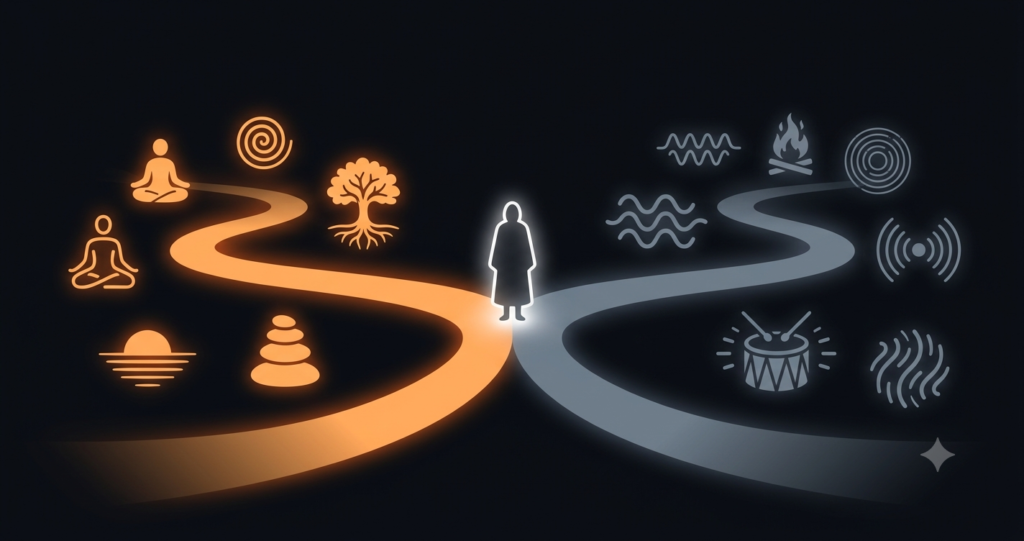
Generic nervous system regulation advice often treats “calming down” as a single, universal goal, applying the same handful of techniques regardless of the underlying state. In practice, sympathetic activation and dorsal vagal shutdown are close to physiological opposites, and the techniques that help one can actively work against the other. Matching the approach to the actual state is the difference between an intervention that helps and one that quietly makes things worse.
See also: “The Polyvagal Ladder Explained” — for background on these two distinct states.
Why One Approach Doesn’t Fit Both States
Sympathetic activation involves too much mobilized energy with nowhere productive to go; dorsal vagal shutdown involves too little available energy to mobilize at all. A technique designed to discharge excess energy — vigorous exercise, for example — can be exactly right for sympathetic activation and exactly wrong for dorsal vagal shutdown, where the body may not have the resources to engage with it, and pushing through can deepen the shutdown rather than resolve it.
The reverse is also true: gentle warmth and stillness, ideal for dorsal vagal shutdown, may do little to address the urgent, mobilized energy of sympathetic activation, since it doesn’t provide the discharge that state specifically needs. This is a core part of what nervous system regulation techniques actually describes.
What Helps Sympathetic Activation
Because this state involves genuine physical mobilization, techniques that help discharge that energy tend to work best. Vigorous movement — a brisk walk, shaking out the limbs, jumping jacks — signals to the nervous system that the mobilization has been used, supporting a return to baseline. Slow breathing with an extended exhale, such as the 4-7-8 technique, directly counters sympathetic arousal. Cold water on the face or wrists can also help interrupt acute sympathetic spikes quickly. This is a core part of what nervous system regulation techniques actually describes.

What Helps Dorsal Vagal States
Dorsal vagal shutdown requires a fundamentally different approach. Because this state reflects depleted resources rather than excess energy, gentle, low-demand practices work better than anything requiring exertion. Warmth — a warm blanket, a warm drink, gentle physical comfort — tends to help, as does slow, undemanding movement rather than vigorous exercise. The calm presence of a trusted person, offering co-regulation rather than requiring active engagement, is often more effective for this state than any solitary technique. This is a core part of what nervous system regulation techniques actually describes.

Regulation Techniques Side by Side
| Technique Type | Sympathetic Activation | Dorsal Vagal Shutdown |
| Movement | Vigorous — walking briskly, shaking out tension | Gentle — slow stretching, brief undemanding walks |
| Breathing | Extended exhale (4-7-8) | Slow, natural breathing without forced structure |
| Temperature | Cold water on face/wrists | Warmth — blankets, warm drinks |
| Social contact | Can help, but may feel like too much at peak activation | Calm, low-demand presence tends to help significantly |
| Overall goal | Discharge excess mobilized energy | Gently restore available energy and safety |
Why Misapplied Techniques Can Backfire
Applying a sympathetic-focused technique, like vigorous exercise, to someone in dorsal vagal shutdown can feel aversive or simply impossible, since the body genuinely lacks the mobilized energy that exercise assumes is available. Conversely, applying a dorsal-focused technique, like sitting quietly and resting, to someone in acute sympathetic activation often fails to provide the discharge the mobilized energy actually needs, sometimes leaving the person feeling more agitated rather than calmer, since the excess energy has nowhere to go.
See also: “Which Breathing Technique Matches Your State?” — for a closer breakdown of specific breathing approaches for each state.
Identifying Which State You’re Actually In
Before selecting a technique, it helps to briefly check in physically: is there a felt sense of excess energy, urgency, or restlessness (suggesting sympathetic activation), or a felt sense of heaviness, numbness, and depleted energy (suggesting dorsal vagal shutdown)? This brief check can prevent the common mistake of defaulting to whichever technique is most familiar or most commonly recommended, regardless of whether it actually matches the current state.
Blended States Require a Different Approach
For blended patterns, such as blended freeze or reactive collapse, neither a purely sympathetic-focused nor a purely dorsal-focused technique tends to work well on its own, since both systems are involved simultaneously or in rapid alternation. These patterns often benefit more from gentler, dual-purpose approaches — grounding techniques that provide some structure without demanding vigorous exertion, combined with a calm, low-pressure supportive presence — and frequently benefit from professional guidance given their complexity.
See also: “Blended Freeze: When Your Body Is Flooded and Frozen at the Same Time” and “Reactive Collapse: When Your Nervous System Can’t Find a Baseline” — for more detail on these specific blended patterns.
Building a Personal Toolkit Across States
Rather than committing to a single favorite technique, it tends to help to build familiarity with a small set of options across both categories — one or two sympathetic-focused techniques and one or two dorsal-focused techniques — so that whichever state shows up, a genuinely matched option is already familiar rather than something being learned for the first time under stress. This is part of why structured assessments that identify the current state can be particularly useful in practice: they remove the guesswork of trying to self-diagnose which category applies in a given moment, especially when the answer isn’t immediately obvious.
Key Takeaways About Nervous system regulation techniques
To summarize the core points on nervous system regulation techniques: it reflects a real, physiological pattern rather than a mood or a character trait, it can be recognized through specific physical and behavioral signs, and understanding nervous system regulation techniques tends to change what actually helps, compared to generic stress advice. Keeping nervous system regulation techniques in mind as a concrete, nameable pattern — rather than a vague sense of “stress” — is usually the most practical starting point.
Recognizing nervous system regulation techniques for what it is tends to be more useful than trying to push past it. Much of the confusion people feel comes from not having a name for nervous system regulation techniques in the first place. Once nervous system regulation techniques is named clearly, the appropriate response usually becomes more obvious. Nervous system regulation techniques isn’t a flaw — it’s a pattern the body has learned, and it can shift with the right approach.
Frequently Asked Questions
How can someone tell which state they’re in before choosing a technique? A brief physical check-in — noticing whether there’s a sense of excess urgency and energy, versus heaviness and depletion — usually indicates whether sympathetic or dorsal vagal patterns are more dominant.
Can the wrong technique make things worse? Yes. Vigorous exercise applied to dorsal vagal shutdown can deepen exhaustion, while purely passive rest applied to sympathetic activation may fail to discharge the mobilized energy, sometimes leaving a person feeling more agitated.
What works for blended states like blended freeze? Gentle, dual-purpose approaches — grounding combined with calm, low-pressure connection — tend to work better than techniques designed for a single, uncombined state, and professional support is often valuable given the added complexity.
Is there one technique that works for every state? No single technique reliably works for both. Matching the approach specifically to the current state produces meaningfully better results than relying on one default method regardless of what’s actually happening physiologically.
For more on the nerve pathway these techniques ultimately work through, see the vagus nerve on Wikipedia.
Where to Start
The Nervous System State Profiler is a free 51-question assessment that identifies which state is currently active, making it easier to select a genuinely well-matched regulation technique rather than guessing. Take the free assessment for a clearer picture.