
Fight flight freeze fawn are four terms that describe how the nervous system responds under threat.
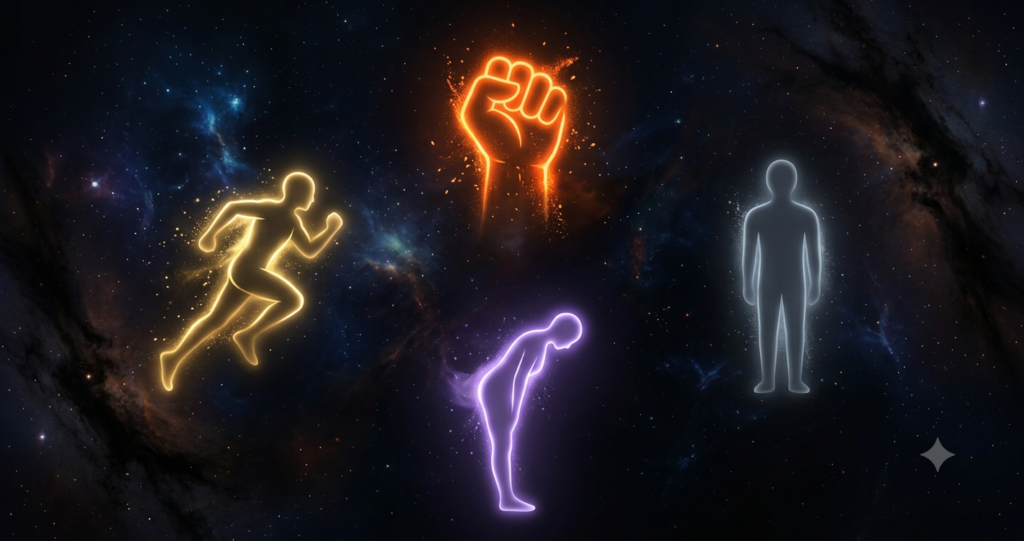
In This Article – Where These Four Responses Come From – The Four Responses, One at a Time – Why Fawn Doesn’t Fit as Neatly – Why These Responses Aren’t a Choice – Recognizing a Pattern Over Time – How These Responses Show Up Day to Day – Why the Same Person Can Show Different Responses – Key Takeaways About Fight flight freeze fawn – Frequently Asked Questions – Where to Start
Fight, flight, freeze, and fawn are four terms that describe how the nervous system responds under threat. The first two are familiar to almost everyone; the second two — freeze and fawn — are less well understood, despite being just as common. All four map directly onto the states described by polyvagal theory, and understanding the mapping makes each response far easier to recognize in daily life.
See also: “What Is Polyvagal Theory?” — for the underlying framework these four responses are built on.
Where These Four Responses Come From
Fight and flight are the original terms, coined in the early twentieth century to describe the sympathetic nervous system’s mobilization response to danger. Freeze was added later as researchers recognized that mobilization isn’t the only possible response — sometimes the nervous system shuts down instead of gearing up. Fawn is the most recently popularized addition, describing a response oriented around appeasing a perceived threat rather than escaping or confronting it. Together, the four terms cover the practical range of ways a nervous system can respond when it detects danger, whether the danger is physical, social, or emotional. This is a core part of what fight flight freeze fawn actually describes.
The Four Responses, One at a Time
Fight
The fight response mobilizes the body to confront a threat directly. Heart rate rises, muscles tense, and attention narrows sharply onto whatever is perceived as the source of danger. In modern life, this rarely looks like physical combat — it more often shows up as irritability, a sharp tone, an urge to argue, or a flash of anger that feels disproportionate to the actual situation. The physiological signature is the same regardless of whether the “threat” is a wild animal or a frustrating email.
Flight
The flight response mobilizes the body to escape rather than confront. The physiological markers overlap heavily with fight — elevated heart rate, narrowed focus, readiness to move — but the behavioral output differs: an urge to leave the room, avoid a conversation, change the subject, or physically walk away. Restlessness, an inability to sit still, and a racing need to “just do something” are common everyday expressions of this response. This is a core part of what fight flight freeze fawn actually describes.
Freeze
The freeze response corresponds closely to the dorsal vagal state in polyvagal theory. Rather than mobilizing, the nervous system shuts down — numbness, disconnection, a sense of being unable to move or speak, and low energy. This response tends to activate when neither fighting nor fleeing feels viable, often in situations of overwhelming or inescapable threat. It’s frequently mistaken for calm from the outside, since a person in freeze isn’t visibly agitated, but the internal experience is closer to paralysis than peace.

Fawn
The fawn response involves appeasing or accommodating a perceived threat in order to reduce it — agreeing quickly, apologizing preemptively, prioritizing another person’s comfort or mood above one’s own needs, and avoiding conflict at almost any cost. This response develops most often in situations where fighting or fleeing genuinely wasn’t safe or possible, such as prolonged relational or developmental threat, and it can persist long after the original circumstances have changed, showing up later as chronic people-pleasing or difficulty setting boundaries.
![[IMAGE PROMPT — Supporting Image 2] Realistic photograph of a person mid-stride running outdoors, tense urgency, natural daylight, no text. Recommended size: 1200 x 800px (landscape, standard inline blog width) Placement: After the “Flight” section. Alt text: Person in a flight stress response, running outdoors.](https://whispersofvoid.com/wp-content/uploads/2026/08/Gemini_Generated_Image_ksgdn7ksgdn7ksgd-1024x687.png)
The Four Responses at a Glance
| Response | Polyvagal State | Core Drive | Common Everyday Sign |
| Fight | Sympathetic | Confront the threat | Irritability, sharp tone, sudden anger |
| Flight | Sympathetic | Escape the threat | Restlessness, urge to leave or avoid |
| Freeze | Dorsal Vagal | Shut down entirely | Numbness, feeling stuck or unable to act |
| Fawn | Blended sympathetic/social engagement | Appease the threat | People-pleasing, preemptive apologizing |
Why Fawn Doesn’t Fit as Neatly
Fight, flight, and freeze map cleanly onto sympathetic activation and dorsal vagal shutdown. Fawn is more complicated, since it borrows from the social engagement system — the same system responsible for genuine connection in the ventral vagal state — but deploys it defensively rather than from a place of authentic safety. This is part of why fawn responses can be so hard to recognize in the moment: they look like kindness or accommodation from the outside, and can even feel that way internally, while actually functioning as a threat response underneath.
See also: “Nervous System Dysregulation in Relationships: Why You Shut Down or Blow Up” — for how these responses tend to play out specifically in close relationships.
Why These Responses Aren’t a Choice
None of these four responses are consciously selected in the moment. They’re the output of neuroception — the nervous system’s below-conscious detection of safety and threat — reacting to cues before deliberate thought has a chance to weigh in. This is why willpower-based advice (“just calm down,” “just speak up for yourself”) tends to fail: it asks a person to override a response that was never produced by conscious reasoning in the first place. Meaningful change usually comes from addressing the underlying state — building genuine safety cues over time — rather than attempting to suppress the response directly in the moment it occurs.
Recognizing a Pattern Over Time
Most people default to one or two of these four responses more than the others, shaped heavily by history and repeated experience. Someone who leaned on fight responses through much of life may find that pattern activates first under new stress, even in situations where fawn or flight might serve them better. Recognizing a default pattern — rather than judging it — is usually the first useful step, since it opens the door to noticing the pattern happening in real time, which is a prerequisite for eventually building more flexibility across all four responses rather than being limited to just one.
How These Responses Show Up Day to Day
Recognizing these four patterns in real situations is often more useful than the technical definitions alone. A fight response might show up as snapping at a partner over something minor after a difficult day at work — the actual trigger being cumulative stress rather than the small thing that set it off.
A flight response might look like repeatedly finding reasons to leave a family gathering early, or compulsively checking a phone during an uncomfortable conversation as a way of mentally exiting without physically leaving. A freeze response can show up as going completely blank during a performance review, unable to recall simple facts or respond to direct questions, even when the content is genuinely familiar. A fawn response often looks like agreeing to take on extra work despite already being overwhelmed, simply because saying no in the moment felt too risky to attempt.
None of these examples involve a person consciously choosing the response. In each case, the nervous system detected some form of threat — social, emotional, or physical — and produced the response that has historically felt safest, often based on patterns established much earlier in life. This is precisely why simply telling someone to “just say no” or “just speak up” rarely works as advice: it treats a physiological reflex as if it were a decision made with full conscious access, when in most moments it isn’t.
Why the Same Person Can Show Different Responses
It’s common for one person to default to different responses depending on context — fight at home, fawn at work, freeze in unfamiliar social situations. This isn’t inconsistency; it reflects how neuroception calibrates differently based on the specific cues present in each environment.
A workplace hierarchy might trigger fawn responses that would never appear in a peer relationship, while an unfamiliar crowd might trigger freeze in someone who never freezes around close friends. Understanding this context-dependence helps explain why a single label like “I’m a fighter” or “I’m a people-pleaser” rarely captures the full picture — most people carry more than one pattern, deployed selectively depending on where the nervous system currently senses the most risk.
Key Takeaways About Fight flight freeze fawn
To summarize the core points on fight flight freeze fawn: it reflects a real, physiological pattern rather than a mood or a character trait, it can be recognized through specific physical and behavioral signs, and understanding fight flight freeze fawn tends to change what actually helps, compared to generic stress advice. Keeping fight flight freeze fawn in mind as a concrete, nameable pattern — rather than a vague sense of “stress” — is usually the most practical starting point.
Recognizing fight flight freeze fawn for what it is tends to be more useful than trying to push past it. Much of the confusion people feel comes from not having a name for fight flight freeze fawn in the first place. Once fight flight freeze fawn is named clearly, the appropriate response usually becomes more obvious. Fight flight freeze fawn isn’t a flaw — it’s a pattern the body has learned, and it can shift with the right approach. Most people encounter some version of fight flight freeze fawn without ever connecting it back to the nervous system directly.
Most people can recognize fight flight freeze fawn patterns in themselves once the four terms are laid out clearly, even if they never had this language for it before. Naming fight flight freeze fawn accurately, rather than just calling everything “stress,” tends to make the pattern easier to work with.
Frequently Asked Questions
Are fight, flight, freeze, and fawn all equally common? Fight and flight are the most widely recognized, but freeze and fawn are just as common — they’re simply less visible from the outside and less frequently discussed.
Is fawning the same as being a people-pleaser? Chronic people-pleasing often originates from a fawn response, but not every accommodating behavior is a threat response — the distinction is whether the behavior is driven by genuine safety and choice, or by an underlying sense of danger that makes saying no feel unsafe.
Can someone have more than one response at once? Yes — blended patterns, such as sympathetic activation paired with dorsal vagal shutdown, are common and are sometimes described separately as blended freeze.
Which response is “best”? None — all four evolved for genuine protective purposes. The goal isn’t eliminating any of them, but building enough flexibility to move between states rather than defaulting to one response regardless of whether it fits the actual situation.
For more on the physiological basis of these responses, see the fight-or-flight response on Wikipedia.
Where to Start
The Nervous System State Profiler is a free 51-question assessment that maps which of these underlying nervous system states — including blended patterns — is currently most active, rather than relying on self-report of which stress response feels most familiar. Take the free assessment for a clearer picture.